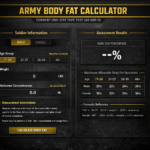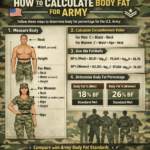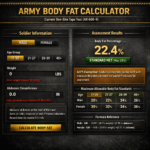
This Army Body Composition Program calculator computes body fat percentage using methods from the Army Body Fat Assessment.
Army Body Composition
Official Body Fat Percentage Calculator
Personal Information
Body Measurements
Your Results
Measurement Guidelines
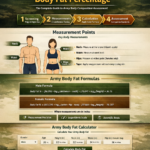
📏 Neck Measurement
Measure at the point of minimal circumference, just below the larynx (Adam’s apple).
📏 Waist Measurement
Measure at the natural waistline, at the level of the navel. Keep the tape level.
📏 Hip Measurement
Measure at the point of maximal circumference of the buttocks.
📏 Height Measurement
Stand straight against a wall. Measure without shoes for accurate results.
Army Body Fat Standards
| Age Group | Male Standard | Female Standard |
|---|---|---|
| 17-20 | 20% | 30% |
| 21-27 | 22% | 32% |
| 28-39 | 24% | 34% |
| 40+ | 26% | 36% |
Table of Contents
Explore the Army’s body composition standards which emphasize body fat percentage as a crucial metric for physical readiness, This blog delves into the Army Body Composition Calculator, personal measurement requirements, and how to maintain an optimal body composition through nutrition, exercise, and healthy lifestyle habits. Understanding these standards not only enhances individual soldier health but also fortifies collective readiness for military operations.
Introduction to Army Body Composition Standards
The Army places significant importance on body composition standards, which serve as a critical benchmark for assessing the physical readiness of soldiers. Unlike general fitness metrics which often focus solely on weight or body mass index (BMI), the Army’s standards emphasize body fat percentage as a vital indicator of a soldier’s fitness level. These standards are specifically designed to optimize physical performance and enhance overall combat readiness by ensuring soldiers maintain an optimal body composition.
One of the key reasons the Army focuses on body fat percentage is its direct correlation with operational efficiency. Soldiers with excessive body fat may experience limitations in endurance, agility, and strength which can hinder their ability to perform tasks effectively in various operational environments. Maintaining an appropriate balance of muscle and fat is essential for improving performance during training and combat scenarios. As such, the Army establishes specific body fat percentage goals that soldiers must adhere to, reinforcing the necessity of optimized physical condition in military settings.
Furthermore, the Army’s commitment to soldier health extends beyond mere body fat measurements. It encompasses comprehensive fitness programs that aim to support overall well-being and longevity within the ranks Programs emphasize not only achieving the required body composition standards but also promoting a holistic approach to health that includes nutrition, exercise, and mental resilience. This multifaceted strategy fosters an environment where soldiers are physically capable, mentally adept, and prepared to meet the demands of their responsibilities.
Ultimately, understanding and adhering to the Army body composition standards is essential for every soldier, as it impacts their ability to serve effectively By prioritizing these standards, the Army not only enhances individual soldier health but also fortifies collective readiness, ensuring a robust defense force prepared for any challenge.

What is the Army Body Composition Calculator?
The Army Body Composition Calculator is a valuable tool designed specifically for military personnel to assess body fat percentage in relation to body weight This calculator serves an essential purpose in maintaining military readiness by ensuring that service members meet the Army’s standards for body composition. It provides a systematic method to evaluate an individual’s health and fitness level, going beyond mere weight to consider overall body composition.
In the military, maintaining a fit body is crucial for operational effectiveness, and the Army Body Composition Calculator plays a critical role in this endeavor. The calculator utilizes several metrics, including height weight, age, and sex, allowing for a more accurate representation of a soldier’s physical health. By determining the body fat percentage, the calculator provides insight into whether an individual falls within the acceptable range established by Army regulations.
The relationship between body weight and body composition is vital in understanding one’s overall health. While weight can reflect general health trends, it does not account for the proportion of muscle to fat, The Army Body Composition Calculator addresses this important distinction. A soldier may weigh within the standard limits, but their body fat percentage can still indicate health risks or compliance issues. Therefore, this tool is indispensable for leaders and soldiers alike who aim to uphold optimal fitness standards.
By integrating the results from the Army Body Composition Calculator into routine health assessments the Army ensures that its personnel maintain a level of fitness that supports operational readiness. This systematic assessment encourages individuals to take an active interest in their health, fostering a culture of fitness within the military community.
Personal Information Required for Calculation
The Army Body Composition Calculator plays a crucial role in assessing body fat percentage and ensuring that service members meet the required standards. To utilize this calculator effectively, specific personal information is essential, The parameters required include gender, age, height, weight, and various body measurements such as neck, waist, and hip circumference. Each of these elements contributes significantly to the accuracy of the calculation.
Gender is a foundational factor because body composition norms differ between males and females. The calculator employs distinct formulas for each gender to reflect these physiological differences. Age is also vital as metabolic rates and body composition can change over time, influencing body fat distribution and overall health metrics.
Height and weight are basic metrics that form the foundation of any body composition assessment. These measurements assist in determining the body mass index (BMI), which can indicate if an individual falls within a healthy weight range. Additionally, specific body measurements particularly neck and waist circumference are pivotal as they provide insight into fat distribution. A larger waist circumference is often associated with a higher risk of cardiovascular diseases and other health issues.
While the neck measurement can help in calculating lean body mass, hip circumference, when applicable offers further context on fat distribution patterns. Collectively, these measurements not only help in calculating the body fat percentage but also allow for a more nuanced understanding of a soldier’s physical readiness. This comprehensive approach ensures that all factors are considered, enhancing the reliability of the Army Body Composition Calculator.

How to Calculate Your Body Fat Percentage
Calculating your body fat percentage using the Army Body Composition Calculator is a straightforward process that requires specific personal measurements and data inputs. To begin, gather the necessary information: your height, weight, age, sex, and circumference measurements of your waist and neck It is essential to measure these accurately, as they directly influence the calculation of your body fat percentage.
To take waist measurements, use a flexible tape measure placed around the narrowest point of your torso, ensuring it is parallel to the ground. For neck measurements, place the tape measure around the base of your neck. Take care to avoid pulling the tape too tightly; a snug but not compressive fit will yield the best results. After obtaining these measurements, record them along with your other required personal information.
Next, navigate to the Army Body Composition Calculator, which can typically be found on official military fitness or health websites. Input your height and weight in the designated fields first. Following that, enter your waist and neck measurements, ensuring all entries are accurate to produce a valid output. Once you have filled in all required fields, submit the information to obtain your body fat percentage
Understanding the output is crucial. The calculator will provide you with a body fat percentage which is a reflection of your overall body composition. For military personnel, maintaining an appropriate body fat percentage is vital for compliance with fitness standards. Use this information as a guide for your fitness regime and nutritional habits. Tracking changes over time will contribute to achieving and sustaining your desired body composition goals, which are integral for overall well-being.
Understanding Your Results
Interpreting the results from the Army Body Composition Calculator is essential for military personnel aiming to meet the established standards, Once the body fat percentage is computed, it is crucial to understand what these figures signify in relation to Army guidelines and overall health. Body fat percentage is classified into several ranges, which are determined by factors such as age and gender.
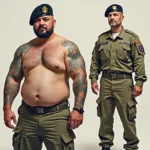
The Army outlines specific body fat standards that differentiate acceptable percentages based on the individual’s age and gender. For male service members a body fat percentage of 18% is typically considered the upper limit for those aged 17 to 20 years, while the threshold rises to 26% for males aged 41 and older. Conversely, female soldiers have a tighter body fat range, with a maximum of 26% for those aged 17 to 20 years and an increase to 36% for those aged 41 and older. These ranges reflect the Army’s commitment to maintaining the physical readiness and operational effectiveness of its personnel.
Results indicating a body fat percentage exceeding the set standards may signal the need for lifestyle changes, including adjustments to diet and physical training. Service members should strive to remain within the healthy ranges to enhance performance and reduce the risk of health-related issues. For individuals falling below the recommended minimum body fat percentages caution is equally important, as excessively low levels can lead to health complications, particularly in women.
In summary, knowing how to interpret your results from the Army Body Composition Calculator helps create a clearer picture of your physical fitness in relation to Army standards, Maintaining an appropriate body fat percentage not only fulfills military requirements but also promotes overall well-being and readiness for duty.

Army Body Fat Standards by Age and Gender
The Army has established specific body fat standards that vary by age and gender, reflecting its commitment to maintaining physical fitness and readiness among service members. These standards serve as benchmarks for evaluating whether a soldier meets the necessary requirements to effectively perform their duties. Understanding these criteria is essential not only for service members but also for anyone interested in military fitness guidelines.
The body fat percentage allowed for males and females is distinctly different due to physiological variations.
For instance, younger males typically have a lower percentage of allowable body fat compared to older males. Similarly, females are held to different standards, acknowledging the natural variations in body composition. Below is a summary of the acceptable body fat percentages by age group for both genders:
| Age Group | Male Body Fat Percentage | Female Body Fat Percentage |
|---|---|---|
| 17-20 years | 20% | 30% |
| 21-27 years | 22% | 32% |
| 28-39 years | 24% | 34% |
| 40 years and above | 26% | 36% |
These age and gender-specific standards aim to ensure that individuals serving in the military are fit to handle the physical demands of military operations., By maintaining these standards, the Army not only promotes personal health but also enhances unit readiness and effectiveness. It should be noted that while these guidelines provide a foundation, individual fitness and performance may vary based on various factors including genetics and training regimen.
Guidelines for Accurate Measurements
Accurate body measurements are vital for ensuring the results obtained from the Army Body Composition Calculator reflect an individual’s true physical state. Specific guidelines outline how to measure the neck, waist, and hip circumferences, as well as the correct method for measuring height. Adhering to these practices will facilitate valid results that comply with Army standards
To begin with, measuring the neck circumference involves using a flexible tape measure. The measurement should be taken at the point just below the Adam’s apple, ensuring that the tape lies flat against the skin without any slack, It is advisable to keep the individual’s head in a neutral position to avoid discrepancies in size. After a thorough measurement, rounding to the nearest half inch or centimeter is appropriate to maintain consistency.
When measuring the waist circumference, it is essential to identify the correct anatomical location. The tape measure should be placed around the narrowest part of the torso, typically located just above the navel. Like in neck measurements, ensure the tape is snug but not tight enough to compress the skin, This measurement should also be recorded in half-inch or centimeter increments. For some individuals, especially those with broader frames, it may be advisable to measure at the level of the navel for an alternative reading that aligns closely with standard practices.
Hip circumference is measured by wrapping the tape measure around the widest part of the hips, typically at the level of the buttocks, Similar to waist measurements, it is crucial that the tape remains level and is not twisted. Maintaining consistency throughout the measurement process will enhance the reliability of the results.
Lastly, height must be measured with precision to ensure an accurate assessment. This can typically be done using a stadiometer or a wall-mounted measuring tape. The individual should stand straight with feet together heels against the wall, and head level, ensuring that any headgear or footwear does not interfere with the measurement. Regular adherence to these guidelines will yield accurate input for the Army Body Composition Calculator.
Common Misconceptions about Body Composition and Fitness
In the military context, understanding body composition is crucial for optimal performance. However, several misconceptions persist that can lead to misunderstandings regarding fitness and health. One prevalent myth is the equation of weight with fitness, Many individuals believe that a lower weight correlates directly with better fitness levels; however, this is misleading. A soldier who has a higher weight due to increased muscle mass may be more fit than a lighter individual with a higher body fat percentage. Therefore, weight alone does not provide comprehensive insights into an individual’s fitness level.
Another misconception is the idea that increasing muscle mass negatively impacts body fat percentage. In reality muscle plays a critical role in enhancing metabolism, which can improve overall health and body composition. It is essential to recognize that muscle contributes to a higher resting metabolic rate, creating a more efficient calorie burn even at rest. This understanding emphasizes that high muscle mass can lead to a healthier body composition, countering the notion that it equates to higher body fat.
Furthermore, the focus on strict numerical metrics can overshadow the importance of holistic health. While military standards often prioritize quantifiable measures such as weight or body fat percentage, overall wellness encompasses various factors, including nutrition, mental well-being, and physical performance. A solely quantitative approach can diminish the importance of cardiovascular health flexibility, and endurance, which are vital for military effectiveness. To truly foster a culture of fitness within military ranks, it is imperative to adopt a more comprehensive view of health, focusing on body composition as a part of a larger health narrative rather than as a standalone metric.
Maintaining a Healthy Body Composition
Achieving and maintaining a healthy body composition is crucial, particularly for military personnel who are required to adhere to strict physical standards. This endeavor involves a combination of proper nutrition, consistent exercise, and healthy lifestyle habits. Understanding how these elements work together can significantly enhance one’s ability to reach and sustain body fat standards
Nutrition plays a vital role in body composition. A well-balanced diet, focusing on lean proteins, whole grains, fruits, and vegetables, can help in managing body fat levels. It is essential to control portion sizes and minimize the intake of processed foods, refined sugars, and saturated fats. Nutrient timing which refers to consuming the right nutrients at strategic times, can also support muscle recovery and energy levels, further promoting a healthy body composition. Regular hydration is equally important; drinking adequate water can aid digestion, metabolic processes, and overall health.
Incorporating regular exercise into one’s routine is another key strategy for maintaining a viable body composition, A balanced fitness regimen should include a mix of cardiovascular workouts, strength training, and flexibility exercises. Cardiovascular activities help with calorie expenditure and overall heart health, while strength training is essential for building and preserving lean muscle mass. Flexibility exercises contribute to overall mobility and can prevent injuries, making it easier to stay active.
Moreover, lifestyle habits such as getting sufficient sleep and managing stress levels are integral to successful body composition maintenance. Quality sleep supports recovery, hormonal balance, and metabolic function, while stress management through relaxation techniques – such as meditation or yoga can help prevent emotional eating. By adopting these nutritional, exercise, and lifestyle strategies, military personnel can not only meet the required body fat standards but also enhance their overall wellbeing and readiness for duty.