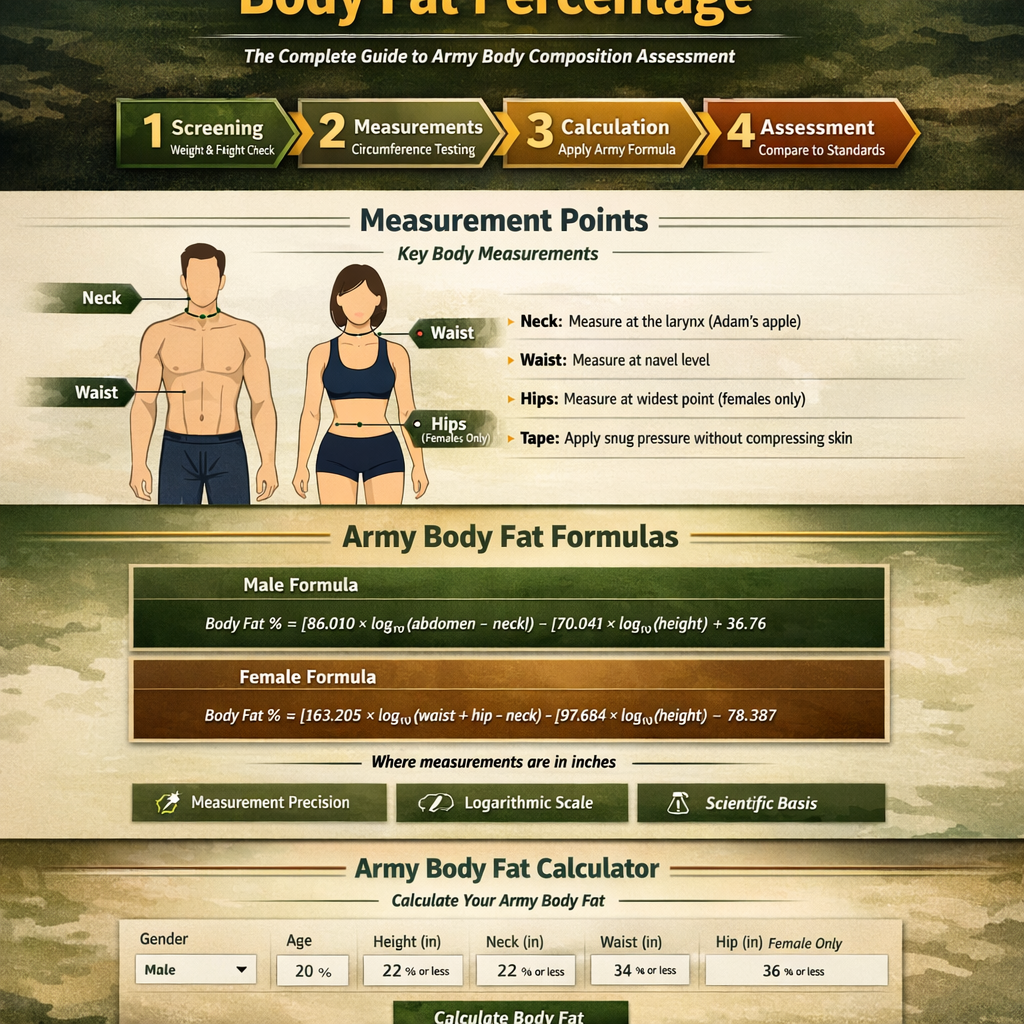
How the Army Determines Body Fat Percentage
The Complete Guide to Army Body Composition Assessment
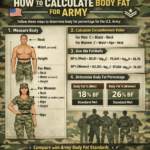
Screening
Weight & Height Check
Measurements
Circumference Testing
Calculation
Apply Army Formula
Assessment
Compare to Standards
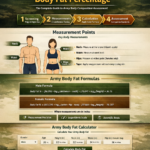
Measurement Points
Key Body Measurements
Measurement Protocol:
- ● Neck: Measure at the larynx (Adam’s apple)
- ● Waist: Measure at navel level
- ● Hips: Measure at widest point (females only)
- ● Tape: Apply snug pressure without compressing skin
Army Body Fat Formulas
Male Formula
Where measurements are in inches
Female Formula
Where measurements are in inches
Measurement Precision
All measurements are recorded to the nearest 1/4 inch. Consistency in measurement technique is crucial for accurate results.
Logarithmic Scale
The formulas use logarithmic calculations to account for the non-linear relationship between body dimensions and fat percentage.
Scientific Basis
These formulas were developed through extensive research on military populations and validated against hydrostatic weighing.
Army Body Fat Standards
| Age Group | Male Standard (%) | Female Standard (%) | Category |
|---|---|---|---|
| 17-20 | 20% or less | 30% or less | Standard |
| 21-27 | 22% or less | 32% or less | Standard |
| 28-39 | 24% or less | 34% or less | Standard |
| 40+ | 26% or less | 36% or less | Standard |
Screening Process
Soldiers are screened annually. Those exceeding weight tables must undergo body fat assessment within 30 days.
Enrollment Standards
New recruits must meet stricter standards: 24% for males, 30% for females, regardless of age.
Flagging System
Soldiers exceeding standards are flagged and entered into the Army Body Composition Program.
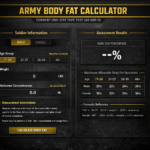
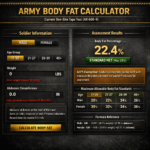
Army Body Fat Calculator
Calculate Your Army Body Fat
Your Results
Body Fat %
–%
Army Standard
–%
Status
—
Note: This is for educational purposes. Official Army measurements must be conducted by certified personnel.
Evolution of Army Standards
1981
First Army body fat standards established using circumference measurements
1987
Updated formulas based on new research with larger sample sizes
2003
Standards revised to reflect changing demographics and fitness levels
2019
Current standards implemented with age-based adjustments and updated formulas
Special Considerations
Athletic Build
Soldiers with high muscle mass may request a body composition assessment if they exceed weight tables but meet fitness standards.
Pregnancy
Pregnant soldiers are exempt from body fat testing for up to 365 days postpartum.
Medical Conditions
Documented medical conditions affecting weight may result in temporary exemptions with proper documentation.
Alternative Methods
For soldiers with physical limitations, alternative assessment methods may be approved by medical personnel.
The Army assesses body fat percentage using a combination of measurements and established guidelines. First, they utilize a standardized method that involves measuring the circumference of specific body areas typically the waist and neck for men, and waist, neck, and hips for women.
These measurements are then plugged into a formula that calculates body fat percentage. This method provides a more comprehensive view of an individual’s fitness level compared to weight alone, as it accounts for muscle mass versus fat mass
Additionally, the Army follows the standards set forth by the Department of Defense, ensuring consistency across all branches, Soldiers are weighed regularly, and if their weight exceeds the allowable limits, a body fat assessment is conducted.
This assessment is crucial not only for maintaining physical readiness but also for overall health and wellness. Maintaining an appropriate body fat percentage is key to meeting the Army’s fitness standards and ensuring operational effectiveness.